• Products
    Products

    lightbulb icon
    Our products

    We're known for our fast, reliable, and user-friendly analog modems that help connect a generation.

    Global product availability
    Dealers
    cellular gateway icon
    Cellular M2M modems and gateways
    USR3513 4G Cellular Gateway
    USR3500 3G Cellular Modem
    USR3510 3G Cellular Gateway
    network tap icon
    Network TAPs
    USR4523 Ethernet Aggregation
    USR4524 Ethernet Aggregation
    4524-MINI Portable Ethernet Aggregation
    USR4525 Multi-mode LC Fiber
    USR4526 Single-mode LC Fiber
    Network TAP accessories
    56k modem icon
    56K dial-up modems
    USR3453C-REF Courier Business Modem
    USR5686G Serial Faxmodem
    USR5630G Serial Faxmodem
    USR5638 PCIe Modem
    USR5639 USB Softmodem
    USR5670 PCI Faxmodem
    USR805671 PCI Faxmodem
    USR802981-OEM OEM PCI Modem
    USR263093-OEM OEM PCI Faxmodem
    USR5686G-PRO Courier Lite Modem
    USR5637 USB Voice Faxmodem
    56K modem accessories
    56K modem comparison

    Products A-Z
    Global product availability
    Dealers
  • Education
    Education

    learning tools icon
    Explore our learning tools

    Use our education essentials to learn about Courier® business products, the Courier® modem brand, how modems work, and how to choose the one that's right for you.

    learning icon
    Start learning
    Education
    information icon
    Courier® business products
    Why buy Courier?
    Out-of-Band connections
    Modem Point of Sale
    Modem technology
    Courier Lite Global Kits
    Courier (3453C) Global Kits
    Courier support
    information icon
    All about dial-up
    History of USR modems
    Modems 101: The basics
    Modem speeds
    V.92 in detail
    What are the different types of modems?
    What kinds of modems are available?
    Getting online with dial-up modems
    Modem applications
  • Support
    Support

    internet icon
    Stay connected

    Updates, drivers, manuals, and other resources to optimize your product's performance and enhance its functionality.

    technical support icon
    Support
    Product registration
    Sales support
    Technical support request
    technical services icon
    Technical information
    Windows compatibility
  • Dealers
  • Company
    Company

    our company icon
    Our company

    USR is a leading provider of global connectivity hardware, trusted by millions of businesses and consumers for over 4 decades.

    overview services icon
    Overview
    About
    Contact
    Partners
    press icon
    Press
    Newsroom
    resources icon
    Resources
    Videos
    Product datasheets
    Case studies
    White papers
    Backgrounder
    Fact sheet
  • Search
  • Contact us
Dial-up modems

Dial-up modems

Modems 101 - The Basics.

Everything you need to know about dial-up modems.

The Basics

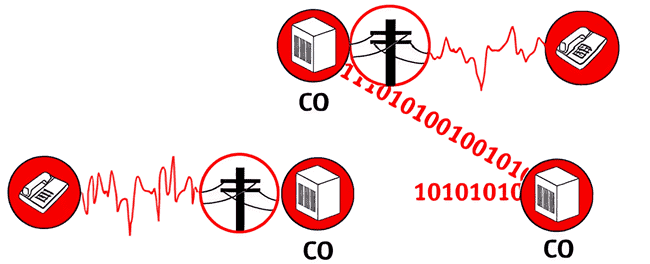
Most phone lines were designed to carry tonal (analog) signals. The Public Switched Telephone Network (PSTN) picks up these tonal signals, and usually converts them into digital signals to transfer them from one Central Office (CO) to another. On the other end, the digital signals are converted back into an analog signal.

How does a computer use a phone line?

"Modem" is an acronym for MOdulator/DEModulator. It converts the digital signal from your computer into an analog signal that can be carried by the phone line, and vice versa. It is also possible to get a digital line (ISDN) installed in your home, but you would need an adapter in order to resolve the different digital signals. ISDN is common in Europe and other areas where Cable or DSL access is not available.
how does a computer use a phone line?

How does a hardware modem work?

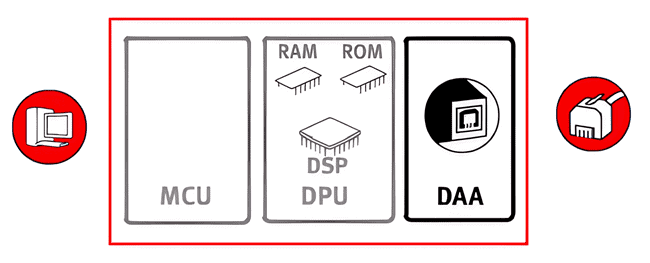
A hardware Modem will have three components: The Microcontroller Unit (MCU), the Data Pump Unit (DPU), and the Data Access Arrangement (DAA). The Microcontroller Unit checks data for errors and performs compression. It may also convert a parallel transmission into a serial transmission. It utilizes the AT command set to send and receive signals. It sends the data on to the Data Pump Unit.

What does the Data Pump Unit do?

When turned on, the Data Pump Unit gets instructions and settings from ROM, the unit's permanent memory. The DSP (Digital Signal Processor) uses RAM (Random Access Memory) while performing its calculations. If your modem has instructions in EEPROM (Electronically Erasable Programmable ROM), it may be possible to upgrade the instruction set in a modem, giving it new features. After processing, the output is sent to the Data Access Arrangement.
what does the data pump unit do?

What does the Data Access Arrangement do?

The Direct Access Arrangement (DAA) serves as the hardware interface to the Public Switched Telephone System (PSTN). A standard RJ-11 jack connects the modem to the phone line. The interface allows the modem to detect signals on the line: dial tone, busy signal, etc.

History of USR modems

Modems 101: The basics

Modem speeds

V.92 in detail

What are the different types of modems?

What kinds of modems are available?

Getting online with dial-up modems

Modem applications

UNICOM divisions

Enterprise software

IT infrastructure

Government technology

Finance & real estate


Useful links

About

Contact

Dealers

Newsroom

Partners

Products

Regulatory compliance

Sitemap


Privacy & legal

Cookies

Legal

Privacy

Do not sell my personal information


Social media

© 2026 USR    |    All rights reserved.